Smells Like Trouble
Carbon water filters exist for one big reason—your tap water might be legally “safe,” but that doesn’t mean it smells (or tastes) like it.
If your water hits your nose before it hits the glass, your body’s telling you what your city report won’t: it’s time to filter out the funk. Chlorine, chemical leftovers, and uninvited odors can turn hydration into hesitation.
That’s where carbon filters come in.
In this guide, we’ll show you how these unsung heroes clean up the flavor, clear out the funk, and turn “technically drinkable” into “actually enjoyable.” You’ll learn what carbon filters remove, where they shine, what they can’t do, and which type works best for your home or business.
Spoiler: your nose and taste buds are about to become carbon filter superfans.
What Is a Carbon Filter (and Why Should You Care)?
At its core, a carbon filter is basically a supercharged sponge made from activated carbon—most often coconut shells, coal, or wood. Sounds humble, but it’s got science on its side. The magic? Surface area. One measly gram of this stuff can have the surface area of a football field. (Yes, really.)
As water flows through, all kinds of unwanted guests—chlorine, funky chemicals, weird smells—stick to that carbon like lint on a sweater. The science term for this is adsorption (with a “d”). That’s when particles cling to the surface of something—unlike absorption, which is what happens when a paper towel soaks up your coffee.
So no, your filter isn’t soaking stuff in like a sponge—it’s grabbing it and holding tight. Think of it like a bouncer for your water: “You look like chlorine. Not tonight.”
And that’s just the beginning.
What Do Carbon Filters Remove?
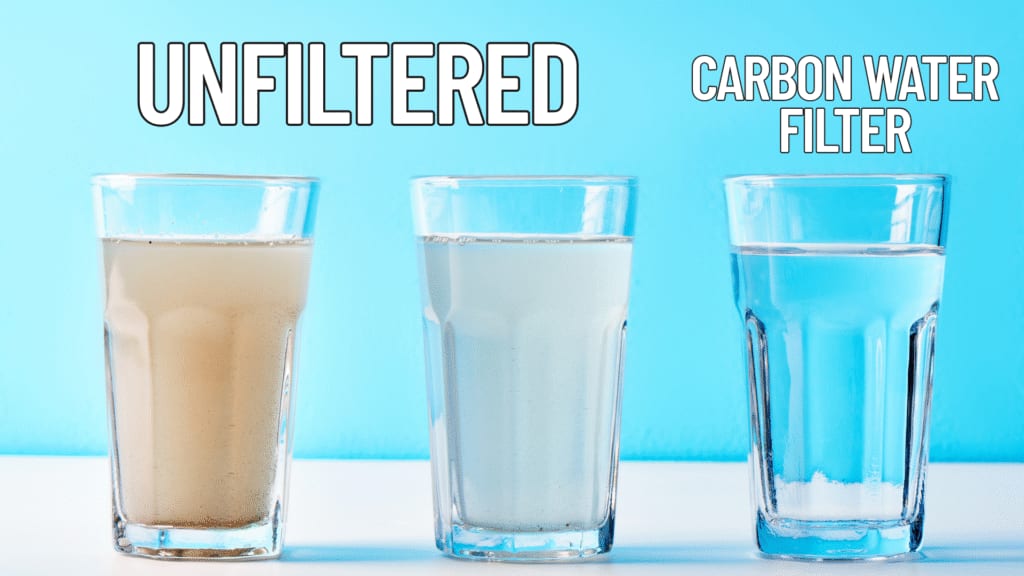
Carbon filters are the cleanup crew your water didn’t know it needed. They don’t just show up—they show off. Here’s what they kick to the curb:
-
• Chlorine – That pool party vibe? Gone. Say goodbye to drinking bleachy bathwater.
-
• VOCs (Volatile Organic Compounds) – AKA the chemical alphabet soup your tap didn’t need.
-
• Pesticides & Herbicides – From field to faucet, but not on carbon’s watch.
-
• Chlorination Byproducts – The sketchy leftovers from making your water “safe.”
-
• Taste & Odor Issues – Musty basement? Metallic mystery? Sulfur surprise? Not anymore.
If your water smells like it’s been working overtime at a chemical plant, a good carbon filter is your best-smelling friend.
What Carbon Filters Don’t Remove
We love carbon filters—but let’s not give them a cape they didn’t earn. Here’s where they don’t shine:
-
• Minerals – They’ll clean the taste, but they won’t soften the water. That calcium crust? Still your problem.
-
• Bacteria & Viruses – If you’re on well water or immunocompromised, you’ll want a UV filter in the mix.
-
• Heavy Metals (like lead or arsenic) – Unless you pair your carbon filter with some extra filtration media, those bad boys can slip through.
Translation? Carbon filters make your water taste amazing—but they don’t make it invincible. Use them right, and know when to call in reinforcements.
Types of Carbon Filters (And When to Use Each)
Not all carbon filters wear the same cape. Some are chill, some are intense, and some are chemical assassins. Here’s the lineup:
-
• Granular Activated Carbon (GAC) – Loose granules = faster flow, looser filtering. Great for general taste improvement, but not the most thorough.
-
• Carbon Block – Tight and compact. Slower flow, but a flavor-fixing powerhouse. If your water tastes like sadness, this one’s your upgrade.
-
• Catalytic Carbon – The elite operator. Specifically trained to remove chloramine, the chlorine alternative that laughs at regular filters.
Quick Decision Guide:
• Got chlorine? Go block.
• Got chloramine? Go catalytic.
• Got both? Time to treat your water like royalty and double up.
Where Should You Use Them?
You don’t need to carbon-filter every drop of water in your house… but hitting the right spots can seriously upgrade your water game:
-
• Under the Sink – Your drinking and cooking water deserves more than Eau de Municipal.
-
• Whole-House System – For those bathing in chlorinated city water. Your skin will thank you.
-
• After a Sediment Filter – Carbon filters hate dirt. Let the sediment filter take the first punch.
-
• In-Line Fridge Filters – Yes, even your ice cubes deserve a taste upgrade. Penny-flavored water is not the vibe.
Business Owners, This Part’s for You
Running a café, salon, rental property, or office? Carbon filters aren’t just for cozy kitchens—they scale. You can install high-capacity systems that handle multiple taps, water stations, or breakroom sinks without losing flow or flavor.
-
• For Spas & Salons: Cleaner water means gentler rinses and better results for hair, skin, and nails.
-
• In Commercial Kitchens: Cooking with filtered water improves flavor and keeps scale from messing with equipment.
-
• Offices & Break Rooms: Your team’s coffee game just got a glow-up. No more “is this a metal mug?” moments.
Heads-up: Bigger setups = more frequent maintenance. Filters might need replacing every 3–6 months depending on use and water quality. But trust us—your guests, clients, and employees will notice the difference.
What Doulos Plumbing Recommends
We’re not into overcomplicating things. If you want water that tastes good, smells decent, and doesn’t make you wonder if you’re drinking from a pool drain—here’s the playbook:
• Go with carbon block for most homes. It’s the best blend of flow rate and filtration power.
• Replace it every 6–12 months. If it’s been over a year, your filter’s just playing dead.
• Always pair it with a sediment filter. Dirt clogs carbon faster than your kids clog toilets.
• Test for chloramine if you’re on city water. (Not all filters can handle that trickster.)
Pro Tip: A clogged carbon filter is just expensive pipe decor. Replace it on time.
Final Thoughts: Smell Ya Later, Chlorine
Carbon filters don’t perform miracles, but they do fix a lot of what’s off in your water—especially the taste and smell that makes you question your life choices every time you take a sip.
So, if your nose twitches and your water tastes “off,” it’s probably not your imagination. It’s just your tap begging for backup.
Live in Twin Falls, Magic Valley, or anywhere in Southern Idaho?
We’ve helped homes and businesses across the region install the right carbon filtration systems—no upsells, no fluff, just clean water that tastes like it should.
Ready to stop sipping mystery water? Contact Doulos Plumbing today and let’s clean up what your city leaves behind.
Quick FAQs
Q: Do I need a carbon filter if I already have a water softener?
A: Yep. Softeners handle minerals, but carbon filters tackle taste, odor, and chemicals. It’s a tag-team situation.
Q: Will it remove that eggy sulfur smell?
A: Maybe, but not always. If it’s serious sulfur, you’ll need a specialized filter—carbon might just mask it temporarily.
Q: Can I use one with well water?
A: Absolutely, but don’t skip the sediment pre-filter. And if bacteria’s a concern, add UV or other disinfection.
Q: How do I know if I have chloramine or chlorine?
A: Check your city’s water quality report (a.k.a. Consumer Confidence Report). Or ask your plumber—we love that stuff.
Doulos Plumbing Team
Serving the Magic Valley with expert plumbing services. From water heaters to sewer lines, Doulos Plumbing is here to help Twin Falls and surrounding communities.